Stop Waiting for the Fed
Push Rewind on Assumable Loans
By Andy Taylor
What it takes up front
A buyer assuming a mortgage takes over the balance remaining on the loan, regardless of the asking price. The seller still wants what the house is worth, so the buyer covers the difference between the two at closing. That difference is the seller's equity, and on a loan that has been paid down for years, and in areas with appreciating home prices, this "equity gap" can be large. It's one of the most common reasons that a loan assumption deal falls apart.
Real-world equity calculations
Here we're running through an example equity gap calculation at numbers close to what you might see on the open market.
Illustrative. A real gap depends on when the loan was written, what the house has done since, and what the seller agrees to.
$115,000 is more than the 20% down payment on a conventional loan at this price, and far more than an FHA minimum. That's the trade an assumption sometimes asks you to make. You can get a rate nobody can offer you today, but this sometimes comes at the cost of more money up front.
It also explains why a loan's balance matters as much as its rate. Two homes can both carry a 3% loan, and the one with a smaller loan balance is the harder purchase because the gap is bigger.
The simpler version of this sumCovering the equity gap doesn't have to be all cash, and in practice, it usually isn't.
Not every servicer permits a second lien behind an assumed loan, and terms vary. Ask before you count on it.
Not every assumption comes with a large gap. A loan written recently, or a house whose value hasn't moved much since, can leave a balance close to the asking price. The gap is the difference between two numbers, and sometimes those numbers sit close together.
For a buyer paying cash it isn't an obstacle either, because the money was coming to the table anyway. That's a bigger share of the market than it sounds: cash took more than half of Southeast Florida's condominium and townhome sales in April 2025, against about a quarter of existing home sales nationally.
The interesting part for a cash buyer runs the other way. Assuming the seller's loan means not spending all of it. Take over a mortgage at 2.5% and most of that cash stays where it is, against a borrowing cost you are unlikely to be offered again. The house gets bought either way. The question is how much of your money is still yours afterwards.
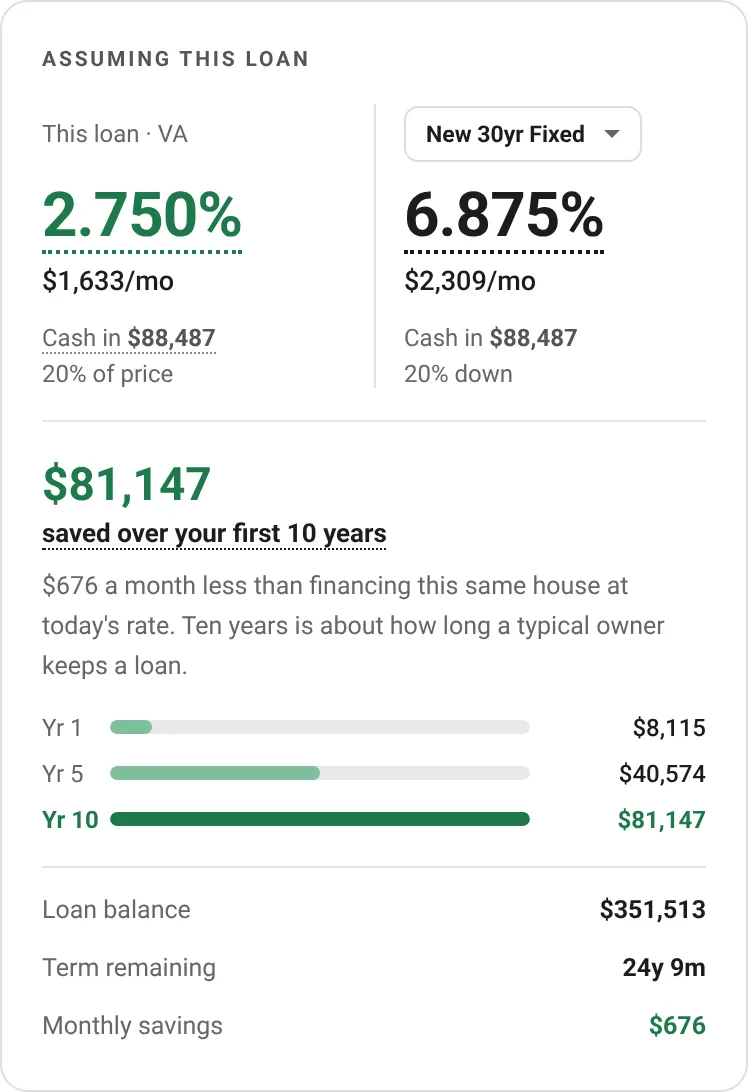
Any comparison between an assumption and a new loan can be rigged by changing how much money the buyer puts down. Put less down on the new loan and its payment looks worse; put more down on the assumption and its payment looks better. This ultimately doesn't tell you anything if you're trying to run an apples to apples comparison.
So most of our savings figures hold the cash to close equal: same money out of pocket on the day, two different loans, and the difference is what the rate is actually worth. That works while the cash an assumption needs stays under 20% of the price. Above that, matching it would mean crediting a new loan with a down payment hardly any buyer makes, which tilts the comparison the other way. So past 20% we show the assumption at the cash it actually takes, against a new loan at 20% down.
An assumption has closing costs like any other purchase. The loan fees are smaller, because nobody is originating a new loan, other fees may be in play, and large fees are typically capped at the servicer level by the FHA and VA.
Compared to the equity gap, the fees are usually negligible, but they're worth knowing as you compare an assumption against other financing options.
An assumption fee set by the lender, closing costs, and a payment to the seller where the home is worth more than the mortgage balance. That last one is usually called the equity gap.
The balance sets how much the buyer covers in cash or other financing to reach the home’s value. Either way the seller takes out their equity, often at a higher price than a conventional sale.
Where the home is worth more than the remaining balance, you pay the difference, which behaves like a down payment. On a home asking $500,000 with $450,000 left on the loan, that difference is $50,000.
If it’s more cash than you have, a second loan can cover the gap, and the blended rate across the two is typically still below what you’d get on the open market.
If the loan carries PMI and the balance is above the threshold, the buyer keeps paying it.
Push Rewind on Assumable Loans
By Andy Taylor

Assumable loan data on all your favorite real estate sites.
By Andy Taylor

Today’s rates are crushing your vibe. What if you could cut your monthly payment by hundreds and own a home you thought was out of reach?
By Greg Fischer

The extension shows the payment on the assumable loan beside a new one, at the same cash to close.
The cash-buyer shares are MIAMI REALTORS, 2 June 2025, reporting April 2025: cash accounted for 52% of Miami-Dade, 57% of Broward and 64% of Palm Beach condominium and townhome sales, against 25% of existing home sales nationally. Those are condominium and townhome figures, and the share across all property types is lower.
The example figures are illustrative and are not a real listing. What a particular loan saves depends on its rate, balance, and remaining term. Estimated payments cover principal and interest only, and don't include taxes and insurance, which make them higher.
Assumption fees come from the rules that set them, not from us. The $1,800 FHA cap is HUD Handbook 4000.1, section II.A.8.n.vi(A), effective 19 August 2024 and unchanged in the 12 August 2026 revision. The VA processing fee cap and the one-half of one percent assumption funding fee are 38 CFR 36.4313(d)(8) and (e)(2), and the location-based addition is VA Circular 26-24-5, 26 February 2024. What a servicer actually charges, and what your state allows, can be less.
RetroRate does not originate loans, determine or extend credit, or engage in lending or mortgage brokering. The original lender or servicer who holds the mortgage handles qualification and approval of new buyers and makes the final decision to extend credit.